
Description
IPTV delivers live television, video on demand and time-shifted viewing over an IP network instead of a traditional broadcast feed. For operators it opens high-value, recurring revenue: the same network that carries broadband can now carry premium video to set-top boxes, smart TVs, phones and browsers.
We design and build the complete chain, from the headend that ingests your content to the app on the subscriber’s screen, using proven, vendor-neutral hardware and today’s streaming standards.
How IPTV works
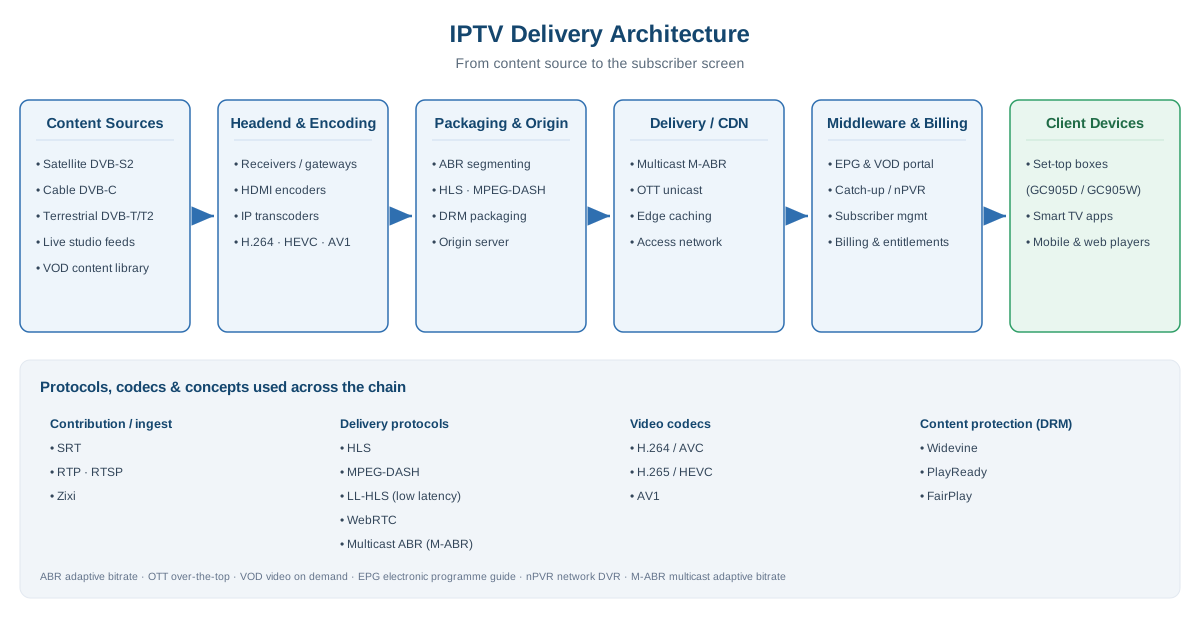
Content enters at the headend, where live channels are received from satellite, cable or terrestrial feeds and on-demand assets are ingested. Encoders and transcoders compress each source into modern codecs and multiple quality levels. A packaging and origin layer then splits the video into small segments, applies encryption, and serves it to the delivery network. From there it reaches subscribers, with middleware handling the channel guide, on-demand catalogue, authentication and billing.
Key components
- Headend and ingest: DVB-S2, DVB-C and DVB-T/T2 receivers, HDMI encoders and DVB-to-IP gateways.
- Encoding and transcoding: hardware and software transcoders producing H.264, HEVC and AV1 in adaptive quality ladders.
- Packaging and origin: adaptive-bitrate segmenting, DRM packaging and the origin server that feeds the network.
- Delivery: multicast for managed networks, unicast and CDN edge caching for OTT reach.
- Middleware and billing: electronic programme guide, VOD portal, catch-up and network PVR, subscriber management and entitlements.
- Client devices: set-top boxes such as the GC905D and GC905W, smart TV apps, and mobile and web players.
Modern streaming concepts
- Adaptive bitrate (ABR): each stream is published at several resolutions and bitrates, and the player switches on the fly to match the viewer’s bandwidth, so playback stays smooth.
- Managed IPTV vs OTT: managed IPTV runs on a controlled network, often with multicast for efficiency; OTT reaches any device over the public internet. Most operators now run both from one platform.
- Low-latency streaming: LL-HLS, LL-DASH and WebRTC cut the delay between live action and the screen to a few seconds, which matters for sports and interactive viewing.
- On-demand and time-shift: VOD, catch-up TV and network PVR let subscribers watch what they want, when they want.
- Content protection (DRM): Widevine, PlayReady and FairPlay secure premium content and satisfy studio licensing requirements.
Protocols and codecs
- Delivery: HLS and MPEG-DASH are the standard adaptive formats, with LL-HLS and WebRTC for low latency and multicast ABR (M-ABR) for efficient managed-network delivery.
- Contribution and ingest: SRT, RTP and RTSP move feeds reliably from source into the headend, including over unmanaged links.
- Codecs: H.264/AVC for broad device support, H.265/HEVC for 4K at lower bitrates, and AV1 for the best efficiency on newer devices.
What we build
We bring these pieces together into a working service tailored to your network: headend and encoding, packaging and DRM, delivery, middleware and billing, and the set-top boxes and apps your subscribers use. Talk to us and we will design an IPTV platform around your content, your network and your budget.